Margin
The distance between a condition’s present state and the point at which the function stops being delivered, or stops being recoverable.
Critical infrastructure resilience
Havelock is a principal-led resilience advisory practice for organisations that run critical infrastructure and services. We track the conditions their systems and suppliers depend on, how fast they are deteriorating, and how long before they fail.
What we all depend on
Energy powers water.
Move across the globe to see what each one holds up.
The systems we built have outgrown the way we watch them. The question is whether they will hold.
It was knowable.
It was not known.
The warning signs are always there, and most have a date. Nobody puts them together.
Nothing sounds. Until an ordinary event becomes a serious one.
Governed by operations, assurance and risk management.
Condition degrading. No event has occurred and nothing has been triggered. Frameworks ask for monitoring; none measures how long is left.
ISO 22320 and ISO 22361. Well served, and expensive.
ISO 22301 and disaster recovery practice. More expensive again.
How we measure it
The unit of measurement is the condition: a testable statement that must hold for a critical function to be delivered and recovered. Most have never been written down. They live with the people who would be called at two in the morning, and are discovered during the incident.
The distance between a condition’s present state and the point at which the function stops being delivered, or stops being recoverable.
The speed and direction in which that margin is being consumed, or restored.
The time remaining before the margin reaches zero. Set against the time it takes to restore, it shows whether action is routine, urgent or already too late.
window = margin ÷ rate
Illustrative example · Remote water sites
“Every remote pump station reports to the control centre.”
Connected. For 120 more days.
The carrier has set the 3G switch-off date. It is in your records.
The network switches off. The sites go silent.
The margin is gone. A failed pump goes unseen until someone drives out.
The last new modem is installed.
If the rollout started today. Sixty days too late.
120 days of signal. 180 days to replace.
Urgent. Start today, and it is still 60 days short. Put manual site checks in place for the gap.
Services
Start with the situation that sounds most like yours. Each service has a written scope, exclusions and a fixed fee, agreed before any work starts.
We test whether your plans would hold today, and show how long each essential service could keep running before action is needed.
What you get Which plans would hold today and which assumptions have lapsed; then a written position for each critical function: what must hold, how much margin remains, how long before action is needed, and who is responsible.
Afterwards, kept current in your own Resilience PlatformFull scope
Starting from your existing BCP and DR plans, name the functions the organisation cannot do without, typically two or three critical services first. Test whether what recovery depends on still holds today, then define the conditions that must hold for each function to be delivered and recovered. Set the thresholds at which intervention is triggered, agreed with the people accountable for the function, including whoever must fund the response, and set it all up in the organisation’s own Resilience Platform, where its people keep it current.
We check your plan against the rules, line by line, and show where your board would be signing without evidence behind it.
What you get The information gaps clause by clause, the points where the board would be attesting to something without evidence behind it, and a recommendation or drafted content for each gap.
Full scope
Would your CIRMP stand up? Havelock reviews your current CIRMP and supporting documents clause by clause against the CIRMP Rules, and identifies where the board would be signing without evidence behind it.
We write the plan and the procedures that make it work: who is responsible, what is checked, and what evidence each step produces.
What you get A CIRMP built to be operated, its definitions and registers, the procedures behind it, and the evidence each rule produces.
Full scope
Having a CIRMP isn’t the same as running one. Define, for your organisation and in line with the Act, its critical components, critical workers and major suppliers; assess them; and write the business rules and procedures that keep the program true, including vendor risk and foreign ownership, control or influence (FOCI) assessment of major suppliers.
We collect the evidence on a set schedule, follow up what is missing, and prepare the board report for you to approve.
What you get Quarterly program reporting, vendor and FOCI assessments, and the board pack and annual report prepared for the organisation to approve and lodge.
Full scope
Havelock runs the program with you. Documents and evidence come in on a set schedule; Havelock tests them against the rules, follows up what is missing, and keeps the CIRMP current. New vendors are assessed as they are engaged.
We look at who owns, controls or influences the organisations you rely on, and where that leaves you exposed.
What you get Where the organisation is exposed, which engagements need further due diligence, and the governance to manage them.
Full scope
Interference. Usually invited. Foreign interference rarely arrives as an intrusion: it comes through acquisitions, investments, research partnerships and suppliers. Havelock reviews the foreign ownership, control or influence (FOCI) behind the partners and suppliers an organisation relies on, for universities and research organisations under the UFIT guidelines, and for government and defence suppliers. Organisations and engagements, never individuals.
Afterwards
The organisation can sign its attestation, show the working behind it, and answer “how do you know?” with evidence rather than a framework.
Resilience Platform
Built on decades of engineering practice in measuring condition against a failure point, the Resilience Platform applies Havelock’s margin and rate method to every critical function an organisation runs. It becomes your in-house resilience team: keeping track of the conditions your systems and infrastructure depend on, updating their status as the evidence comes in, and feeding the work built on them: board reporting, enterprise risk management and business continuity planning.
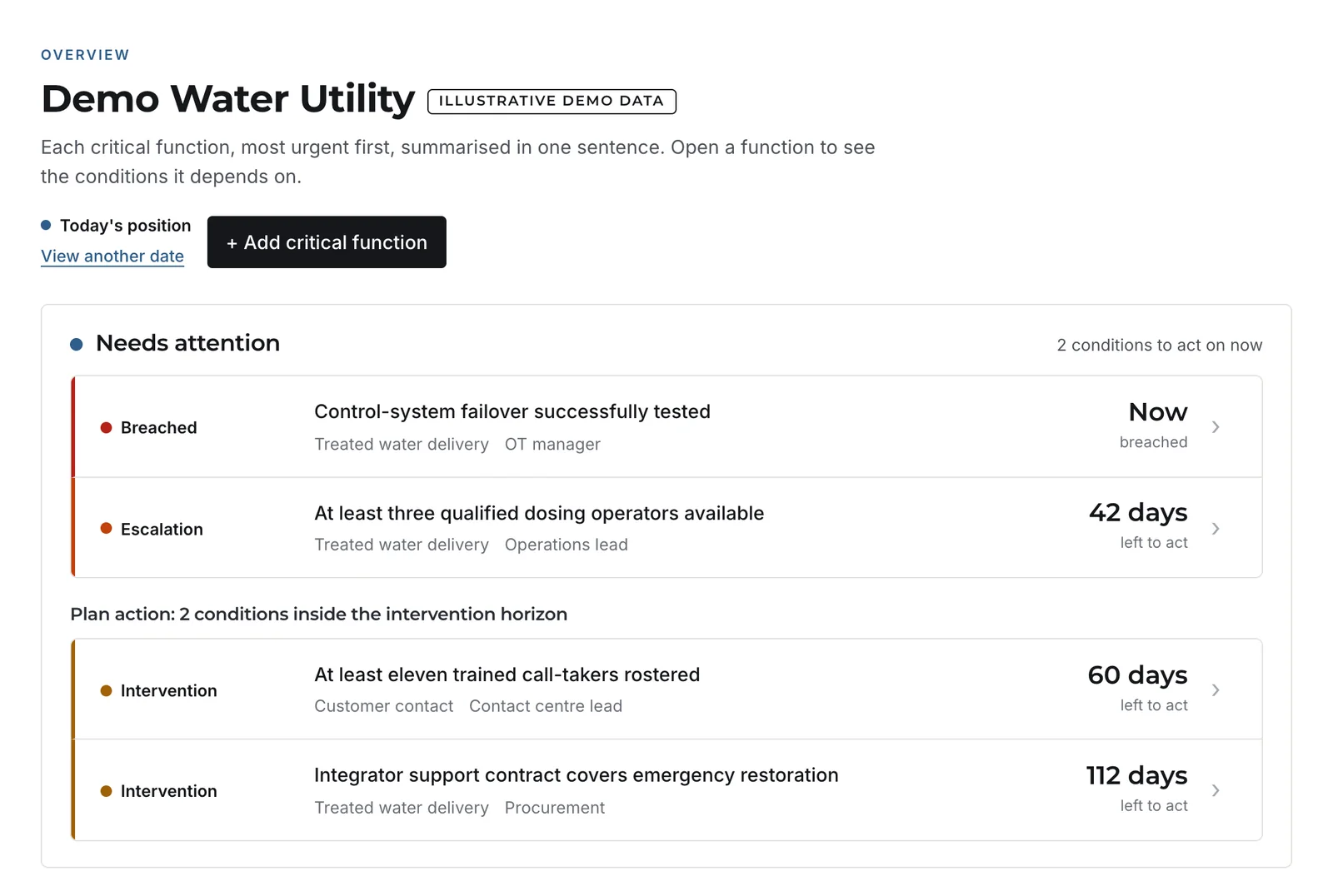
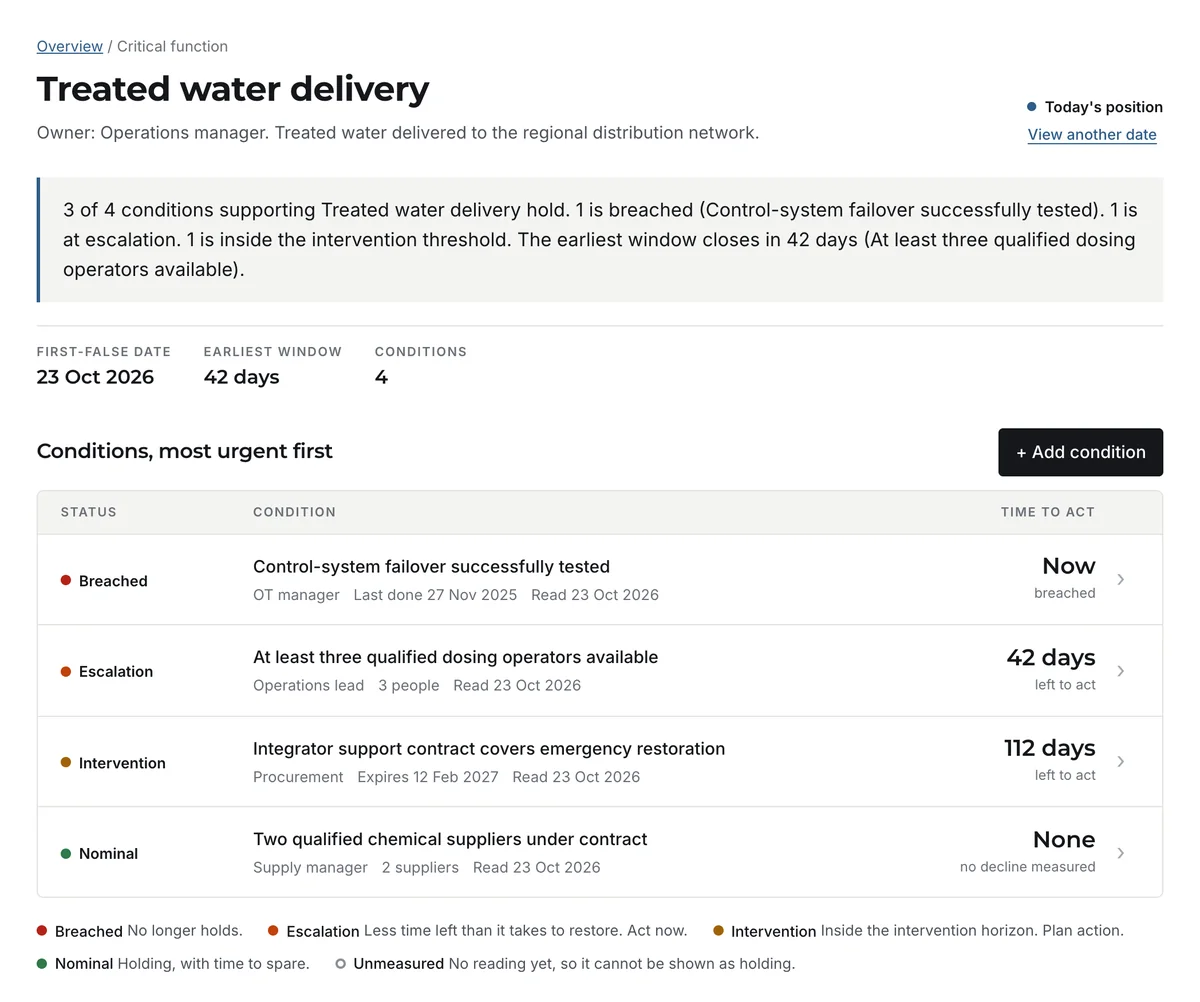
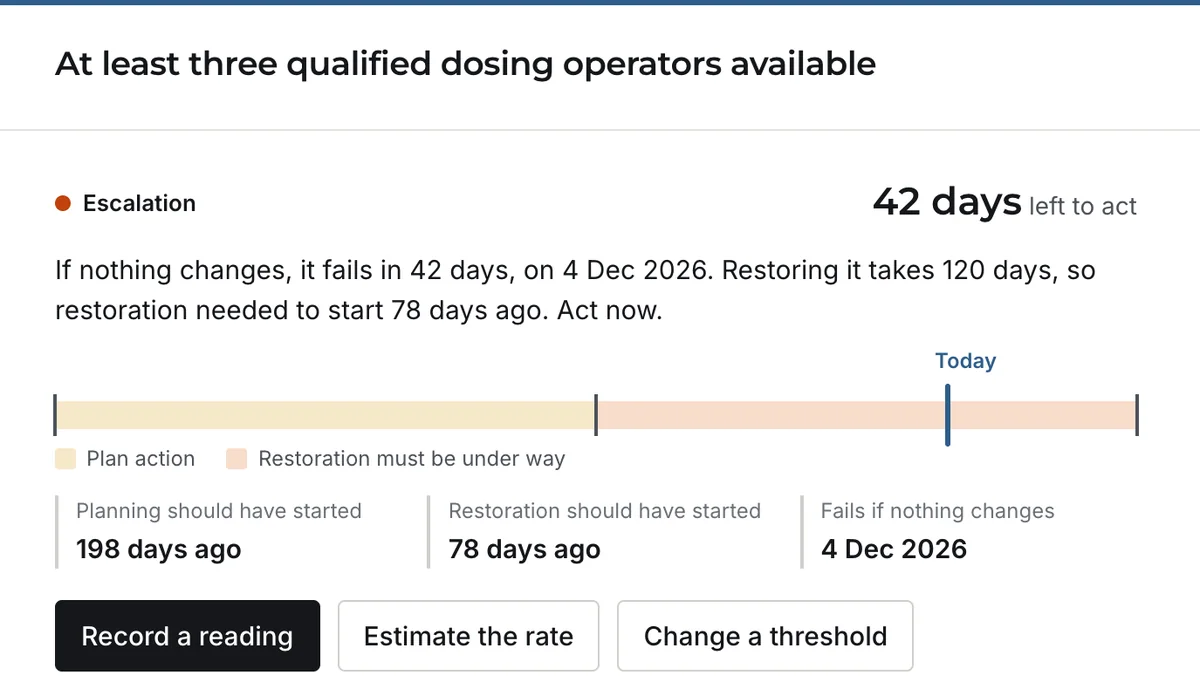
Screens from the working platform, shown with illustrative demo data.
For each critical function, the Resilience Platform holds the written conditions that must stay true, the thresholds agreed for each, and tracks the margin remaining and the rate it is being used up, so the window to act is always known. Havelock is available to review the position each quarter, or to run it for organisations that prefer.
Status Built · client release in development
Record
Clients are described by sector rather than named. Several operate where being publicly listed as a client would itself be inappropriate, and that discretion is part of the service.
Executive risk and security advisory in a high-consequence national intelligence environment. Designed and delivered the business continuity and crisis communications frameworks.
Led the enterprise cyber GRC and resilience function for one of Australia's largest carriers. SOCI assurance, Essential Eight uplift and board-level risk reporting.
Designed and implemented a cyber threat intelligence capability from concept to operational delivery: insider threat, internal vulnerability analysis and foreign interference.
Strategic risk modelling and scenario analysis for pandemic preparedness and domestic resilience planning.
Risk modelling and high-consequence scenario analysis for a proposed national facility, reported directly to the agency's risk board.
SOCI obligations and foreign interference protection for academic and scientific research linked to national security programs, protecting sensitive work from state-sponsored actors.
Country and region threat assessments, contingency plans and crisis response procedures for Australian diplomatic missions across Africa, the Middle East and South-East Asia. Security for UN civilian protection sites and humanitarian operations.
Protective security risk advisory for a nationally significant transport infrastructure project.
Protective security assessments and critical incident response for courts and judicial settings, assessment of correctional facilities, and emergency response planning.
Principal

Founder and Principal Advisor
Rob began his career in the Royal Australian Navy as a cryptologic intelligence analyst in submarines, then spent seven years as an overseas security advisor to Australian diplomatic missions across Africa, the Middle East and South-East Asia. He has since led risk, security and resilience work across Commonwealth agencies, national intelligence environments, research institutions and critical infrastructure. He has held numerous board appointments, and provides dedicated advice to senior political and government officials and the heads of organisations. Every Havelock engagement is led by him personally.
For a direct conversation about a risk position you need to be able to defend. All enquiries are handled in confidence.